


Description
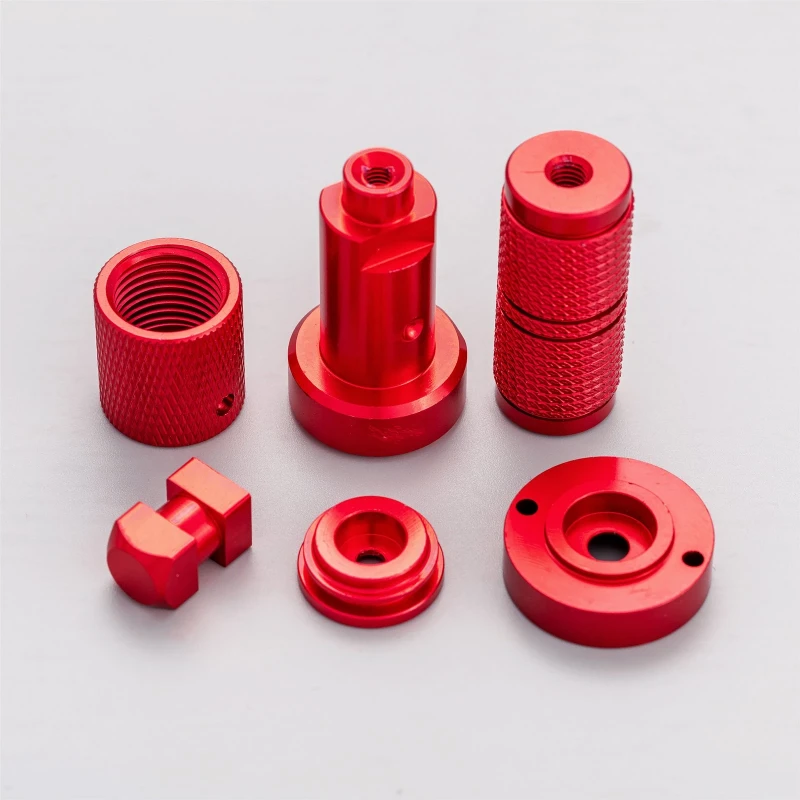
"Leading technology and excellent quality - Choose our OEM CNC turning aluminum parts and enjoy the perfect combination of advanced technology and cutting-edge craftsmanship!"
Our Services
We provide customized solutions for different industries, from aerospace, medical components, electronics to the new energy industry, and more. CNC machining ensures the accuracy and quality of products.
At XYC, our ISO certified CNC workshop is specifically designed for rapid prototyping and small batch production of end use components. XYC CNC Factory provides you with 24-hour quotation service and rapid production of samples. We are your best choice for machining parts and can customize manufacturing according to your project requirements.
Machinable Range
|
Tolerance: |
+/-0.01mm(In CNC machining, The tolerance is largely influenced by the geometric shape and material type of the part. Specific tolerance details for different parts ) |
||
|
Roughness: |
Ra 0.1-Ra 3.2 |
||
|
Quality: |
DIN,ASTM,GOST,GB,JIS,ANSI,BS; |
||
|
Drawing format: |
PDF,DWG,DXF,IGS,STEP |
||
|
Authentication: |
ISO9001:2015,ISO4001:2015,RoHS,SGS; |
||
|
Size: |
Length 1600mm*length 850mm |
||
|
Material |
Steel: carbon steel, alloy steel, stainless steel, 4140, 20 #, 45 #, 40Cr, 20Cr, etc |
||
|
AL: AL6061,AL6063,AL6061,AL7075,AL5052,etc |
|||
|
Stainless steel: 201SS,301SS,304SS,316SS 17-4PH,etc |
|||
|
Brass: C37700,C28000,C11000,C36000,etc |
|||
|
Plastics:PTFE,PEEK,POM,PA,UHMW,PC,PBT,etc |
|||
|
Surface Treatment: |
Steel |
stainless steel |
stainless steel |
|
Galvanization |
Burnishing |
Anodizing |
|
|
Black anodize |
Passivation |
Sandblasting anodizing |
|
|
Nickeling |
Laser marking |
Colorful anodizing |
|
|
Chroming |
Sandblasting |
Wire drawing |
|
|
Heat treatment |
Burnishing |
||
|
Powder coating |
Chroming |
||

There are several common grades of aluminum commonly used in CNC turning due to their excellent performance. Here are some commonly used levels:
6061 Aluminum: 6061 is one of the most widely used aluminum alloys with excellent machining performance. Has good strength, corrosion resistance, and weldability. This brand is commonly used for various CNC turning applications, including automotive parts, mechanical parts, and structural parts.
7075 Aluminum: 7075 is a high-strength aluminum alloy with excellent mechanical properties. It has good fatigue resistance and is commonly used in applications where strength and durability are crucial, such as aerospace components, high-performance bicycle parts, and sports equipment.
5083 Aluminum: 5083 is renowned for its excellent corrosion resistance, especially in marine environments. It has good weldability and is commonly used for CNC turning parts in ship applications, such as ship components, ship accessories, and offshore structures.
2011 Aluminum: 2011 is a free cutting alloy with excellent machinability and good strength. It is commonly used for CNC turning of small parts, electrical connectors, and accessories that require high-speed machining.
6063 Aluminum: 6063 is commonly used in CNC turning profiles and profiles due to its excellent surface smoothness, corrosion resistance, and formability. It often appears in building applications, window frames, and various structural components.
2024 Aluminum: 2024 is a high-strength aluminum alloy with good machinability. It is commonly used in aerospace applications that require high strength and fatigue resistance, such as aircraft components, structural components, and gears.


FQA
What are the advantages of CNC turning?
Reachable: CNC turning can achieve the machining of workpieces, enabling accurate control of their size, shape, and surface quality. By using precision CNC systems and tool compensation, micrometer level machining accuracy can be achieved.
High efficiency: The machining ability to achieve high efficiency in CNC turning. Due to the characteristics of automation, it can terminate complex processing tasks and improve production efficiency. Compared with traditional manual turning, CNC turning can save a lot of manpower and time costs.
Good repeatability: As CNC turning is controlled through computer programs, it can ensure the consistency and repeatability of each machining process. Once the processing parameters and programs are correctly set, each production of the workpiece will have the same accuracy and quality, reducing the impact of human labor on the workpiece.
Flexibility and versatility: CNC turning can adapt to various machining needs. By changing cutting tools and adjusting machining parameters, different shapes, sizes, and materials can be machined. This flexibility makes CNC turning suitable for various complex production parts and components.
Automation control: CNC turning is an automated machining process controlled by computer programs. Operators only need to program, set machining parameters and processes, and manually monitor the operation of cutting tools. This improves the safety of operations and reduces the labor intensity of operators.
Manufacturing consistency: CNC turning can achieve consistency in batch production. By using the same program and processing parameters, it is possible to ensure that each workpiece has the same quality and size, thereby achieving high-quality large-scale production.
What is the accuracy of CNC turning?
The accuracy of CNC turning can reach a very high level, usually at the micrometer level (1 micrometer is equivalent to 0.001 millimeters). The following are common CNC turning accuracies:
Dimensional accuracy: CNC turning can achieve workpiece size control. Usually, linear dimensional accuracy can reach 0.01 millimeters, which means that the deviation of the workpiece can be controlled within a very small range.
Roundness accuracy: CNC turning can achieve roundness accuracy of workpieces. Roundness refers to the degree of deviation between the surface of the workpiece and the spindle. In CNC turning, roundness accuracy can reach 0.005 millimeters or less.
Surface roughness: CNC turning can achieve precision and fine machining of the workpiece surface. By selecting appropriate cutting tools and processing parameters, lower surface roughness can be achieved. Normally, the surface roughness can reach Ra 0.4 micrometers or less.
Parallelism and verticality: CNC turning can achieve control of workpiece parallelism and verticality. Parallelism is the deviation of parallelism between the workpiece surface and the reference plane, while perpendicularity is the deviation of perpendicularity between the workpiece surface and the reference plane. CNC turning can achieve greater parallelism and verticality deviations, typically within a range of 0.01 millimeters or less.
Hot Tags: oem CNC turning aluminum parts, China oem CNC turning aluminum parts manufacturers, suppliers, factory, cnc laser cutting products, CNC Peek Parts, cnc laser cutting and bending, peek plastic machining, cnc polycarbonate sheet, product prototyping services


